
 hammad

API tests catch quiet breakage before it reaches a customer or blocks a release. The best API testing tools make those checks repeatable, but each suits a different job. Here are six picks, with a clear view of what each does well and where it fits.
We analyzed 54 comments and questions from YouTube and Quora about API testing tools and found that 24% mentioned offline lightweight testing tools.
1. Postman: Flexible collections for API regression testing
Postman is a request and test workspace where collections can grow into repeatable endpoint regression suites. It’s a strong fit for developers and QA teams that want to start with a manual check, then run the same requests in CI.
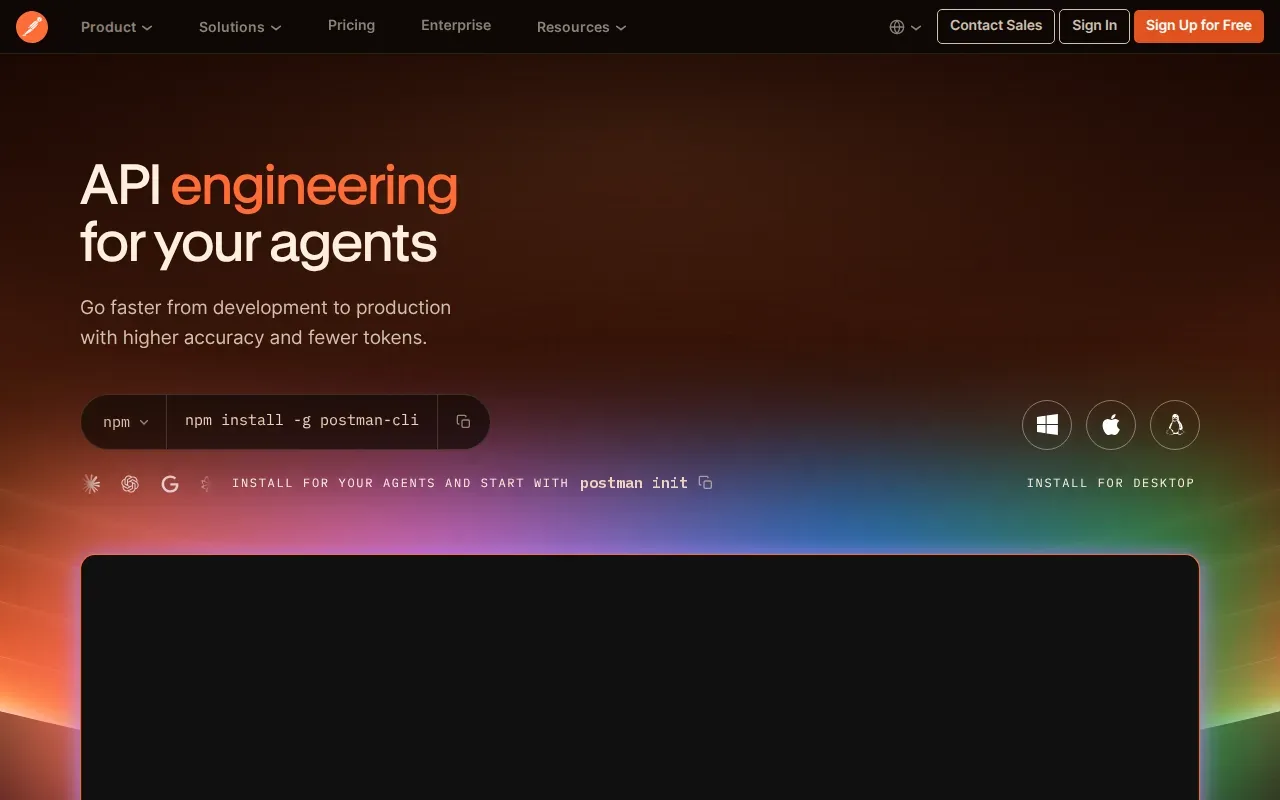
Collections group requests with variables and pre-request scripts. That lets a team reuse setup data, prepare a request, and run related checks together instead of rebuilding each test by hand. The built-in test runner uses JavaScript assertions, so you can check a response’s status, schema, or field values.
A useful test checks more than whether an endpoint returns a success code. For example, a test can confirm that a price is positive, that a returned ID matches the one sent, or that missing authentication leads to the expected error. Those checks help catch changes that break a client even when the endpoint still responds.
Postman supports OpenAPI import, mock server templates, and CI pipelines. Its collections can cover functional checks and contract expectations in one place. The OpenAPI specification describes a standard way to define an API, which can give a team a shared reference when checking whether a response still matches its agreed shape.
For example, put a login request before an account request in the collection. Use the login response to set a variable, then check that the account endpoint returns the expected fields. Run that collection locally while changing the API, then run it in CI to catch a regression before merge.
Trade-off: Deeper governance and environment control call for manual workspace and role management. Postman suits teams that value an adaptable collection workflow, while teams with strict access rules should account for that setup.
2. Apidog: Import-based API regression with CI runs
Apidog is an API design and testing workspace with import-based regression coverage and headless CI runs. It fits teams that already have API definitions or request collections and want to turn them into repeatable checks.
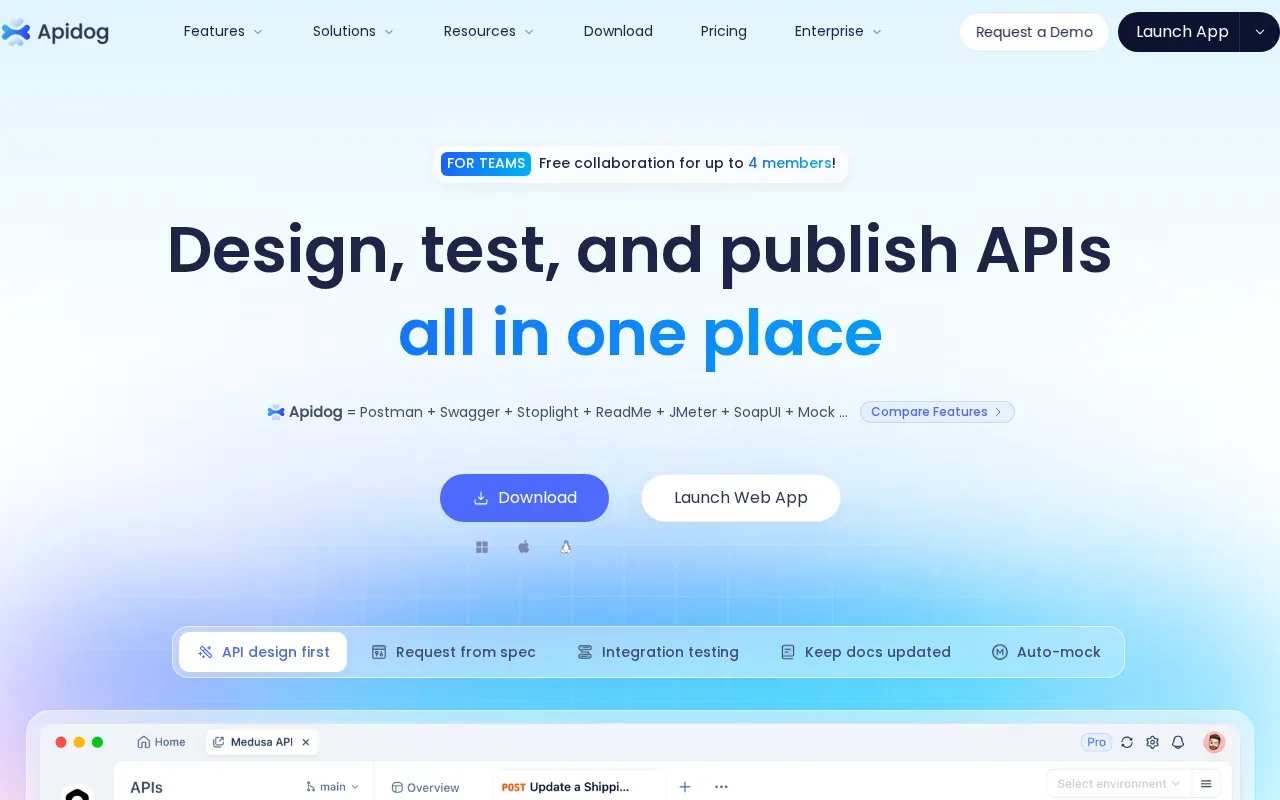
Apidog supports imports from OpenAPI specifications, Postman, Insomnia, cURL, and other formats. That can save setup time when a team is moving an existing API project into a shared test workflow. Imported endpoints can be organized into environment-aware requests and test scenarios.
Regression testing checks that a change hasn’t broken behavior that used to work. In an API project, that may mean running a sign-in request and then checking a related account or order request. Apidog’s test scenarios can pass data between requests, so later tests can use values returned earlier in the flow.
Its CLI can run test suites without the desktop interface. That makes it possible to run the same checks in a CI pipeline after a code change. A team can keep local debugging quick, then use a pipeline run as a consistent gate before a merge or deployment.
Apidog also documents regression, end-to-end, integration, contract, and performance testing workflows. Those labels describe different scopes. A functional check asks if one endpoint behaves as expected; an end-to-end test follows a full user flow across linked requests.
Trade-off: Its governance and customization depth is limited compared with fully code-centric frameworks. Apidog is a good fit when import and CI execution matter more than building every test rule in code.
3. Insomnia by Kong: Collection-based testing with a headless CLI
Insomnia by Kong groups requests into collections and keeps request definitions close to test expectations. It fits developers who want a client-focused workflow for checking APIs, then running the same collection through a headless CLI.
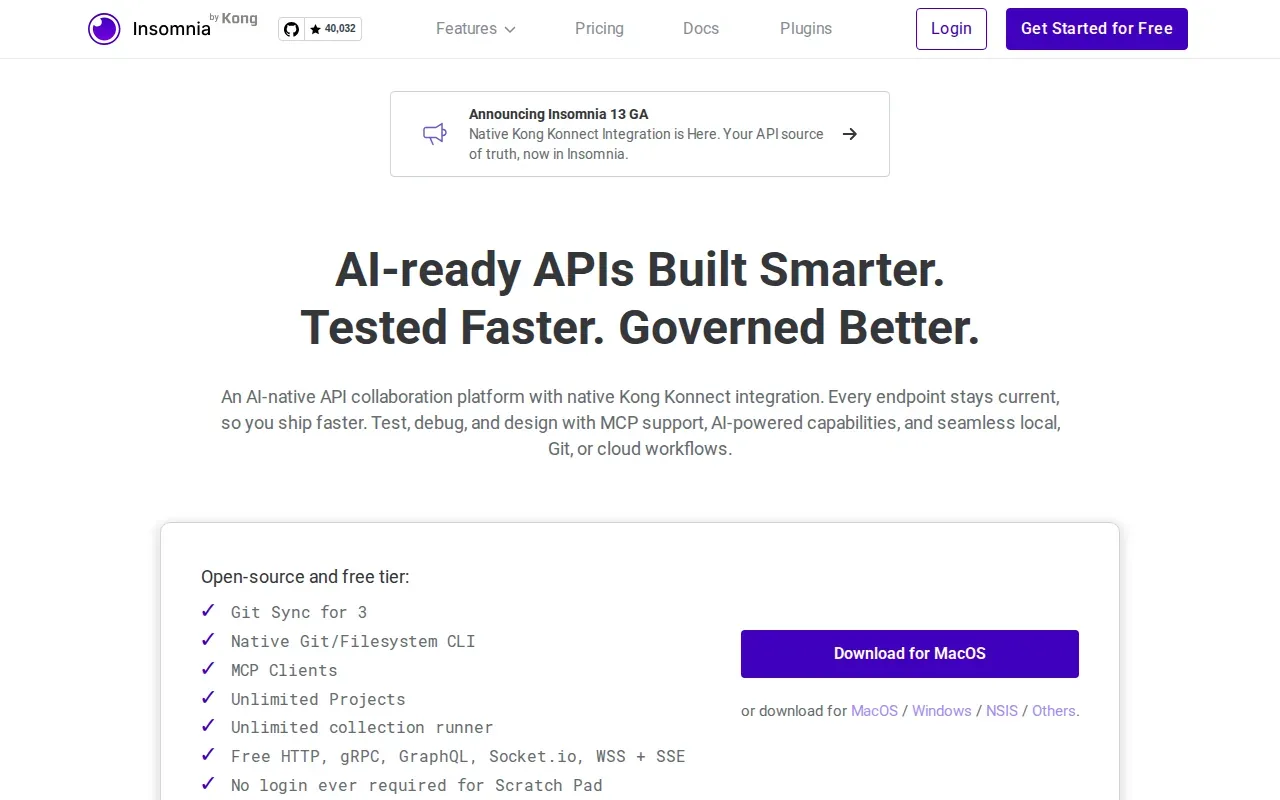
Tests can use JavaScript before a request or after a response. Collections can chain requests, which lets a test pull a value from one response and use it in the next request. That’s useful for a flow such as signing in, saving a token, and checking an endpoint that needs authentication.
The Inso CLI runs collection tests as part of an automated pipeline. For example, a team can make a passing API test run a condition for merging a pull request. The key benefit is consistency: local checks and CI can use the same collection rather than separate test definitions.
Insomnia also supports vault integrations for AWS, GCP, HashiCorp, and Azure. That helps teams keep secrets connected to their existing workflows rather than typing them into request definitions. Its scripting is compatible with Postman tests, which may make it easier to move existing checks across.
Trade-off: Its governance controls are more client-focused, which can limit enterprise-level role-based access control. If centralized permissions are a firm requirement, weigh that before standardizing on it.
4. SoapUI by SmartBear: Broad testing for SOAP, REST, and GraphQL
SoapUI by SmartBear is an open-source tool for testing SOAP, REST, and GraphQL services. It’s a sensible pick for teams that need broad API coverage, especially when SOAP remains part of the system they support.
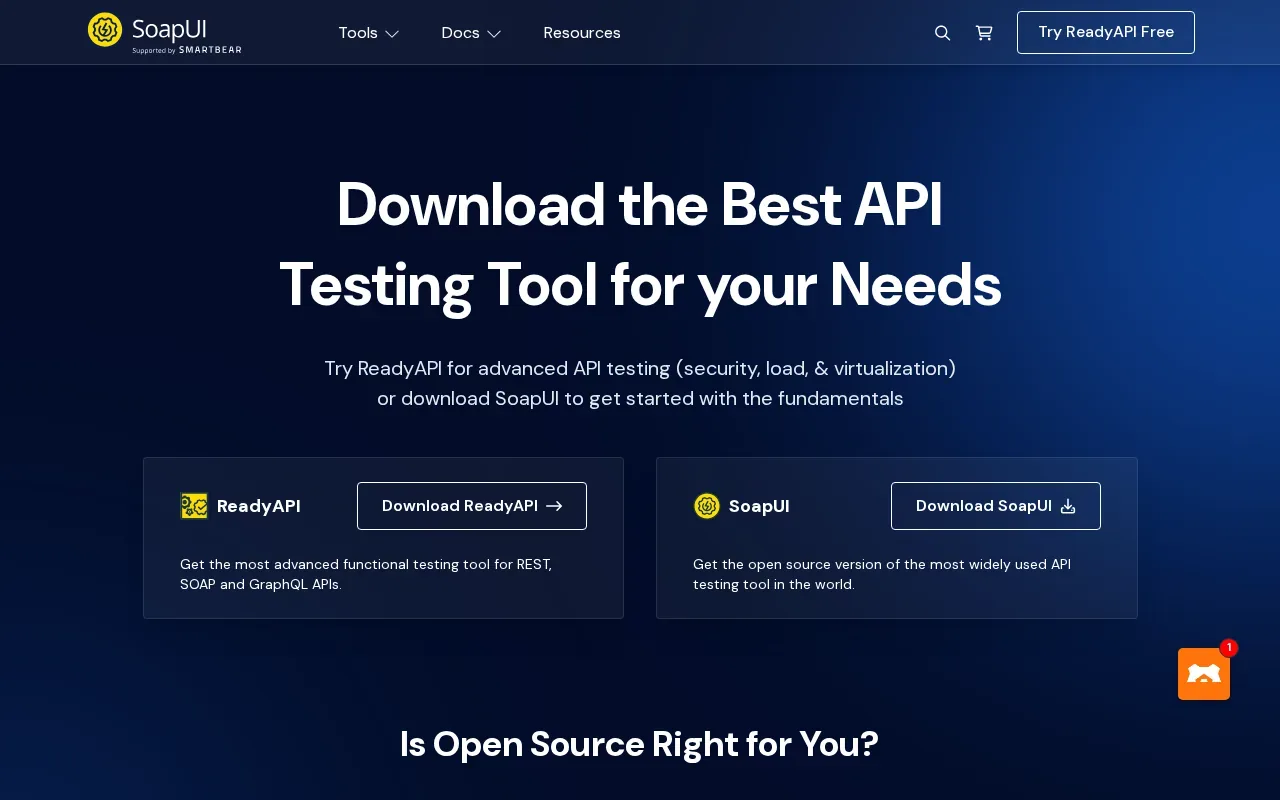
SoapUI Open Source is free. The product’s testing capabilities include functional, security, and load testing. That gives teams a way to cover more than a single response check within one testing tool, though the depth and workflow needs depend on the project.
Functional testing checks whether an endpoint responds correctly to an input. Security testing checks behavior related to security risks, while load testing looks at how a service responds under traffic. These checks answer different questions, so a passing functional test alone shouldn’t be treated as proof of security or performance.
SOAP coverage is the clearest reason to consider SoapUI alongside newer API clients. A team that supports a SOAP service can keep those checks in the same general testing tool used for REST or GraphQL endpoints. That can be useful during a change that touches a newer service but still depends on a legacy integration.
For a REST-only team, the main question is workflow fit. Teams focused purely on REST may find more modern workflows elsewhere in this shortlist. That caveat matters if most of your work is quick request debugging and lightweight regression checks.
Choose SoapUI when SOAP coverage or its free open-source edition is central to the decision. If the team only needs REST checks, compare the collection-based clients before settling on it.
5. Apache JMeter: API performance and load testing
Apache JMeter, by the Apache Software Foundation, tests API performance across HTTP, REST, SOAP, and other protocols. It’s best suited to teams that need load testing and can organize a test plan with care.
JMeter sends protocol-level requests. For an HTTP API, a test plan can define requests, headers, variables, response checks, and the load pattern. This differs from measuring a browser’s page rendering. JMeter focuses on the server-facing request and response.
A simple API flow might send a login request, extract a token, and pass it into a later request. Data-driven plans can use input values from a file, which helps avoid sending the same request data on every run. Assertions mark results as passing or failing, so throughput alone doesn’t hide a run where responses are errors.
JMeter supports headless execution, which allows teams to run tests from CI. A pipeline can use a smaller test as a release check, while a scheduled run applies a larger load pattern. The same plan can be parameterized for different environments rather than edited for every target.
That protocol-level view is a good match for JMeter’s focus: it measures the exchange with the service, not how a browser paints a page.
Trade-off: Large endpoint suites need disciplined test-plan organization. Reusing a sampler with variables can keep similar requests manageable; an unstructured plan becomes harder to maintain as the suite grows.
6. Parasoft SOAtest: Cross-protocol service and microservice verification
Parasoft SOAtest tests REST, SOAP, GraphQL, and microservice interfaces. It’s a fit for teams that need governed regression suites across more than one API style, with automated runs in CI.
SOAtest supports headless CI runs for regression automation. This lets a team run service checks without opening a desktop interface each time. It can help make the same regression suite part of routine pipeline work rather than a test that depends on someone remembering to run it.
Cross-protocol coverage matters when one business flow spans services with different interfaces. A team may need to check a REST service alongside a SOAP dependency, or confirm a GraphQL response as part of a broader service test. Keeping those checks in a shared suite can make a failure easier to trace across the flow.
SOAtest also supports service virtualization and data-driven execution across REST, SOAP, and GraphQL. Service virtualization can help when a test needs a stand-in for a service that isn’t available in the test environment. Data-driven runs can exercise the same test with different input values.
For larger teams, the appeal is the focus on governed API regression across multiple interface types. It is a more specialized choice than a basic request client. Match it to a need for cross-service verification rather than selecting it only for quick manual endpoint checks.
Pick SOAtest when your test suite must span service types and run headlessly as part of CI. Its role is clearest when regression work needs structure across an API estate.
API testing tools compared: coverage, automation, and best fit
These tools overlap, but they don’t all solve the same testing problem. Use the table to match your main need to the tool’s strongest fit, then check the caveat before you commit.
| Tool | Strongest fit | Automation approach | Watch for |
|---|---|---|---|
| Postman | Collection-based functional and regression checks | JavaScript test runner and CI pipelines | Workspace and role setup needs manual governance work |
| Apidog | Imported API projects and regression suites | Headless CLI and environment-aware collections | Less customization depth than code-centric frameworks |
| Insomnia by Kong | Client-focused collection testing | Headless Inso CLI runs | Enterprise RBAC may be a constraint |
| SoapUI by SmartBear | SOAP, REST, and GraphQL checks | Functional, security, and load testing capabilities | Pure REST teams may prefer a more modern workflow |
| Apache JMeter | API performance and load testing | Headless test plans for CI | Large suites need careful plan organization |
| Parasoft SOAtest | Governed, cross-protocol regression | Headless CI runs | Best matched to service verification needs |
Functional tests check whether a request returns the expected result. Integration tests check how services work together. Contract tests check whether an API still matches an agreed specification. Load tests examine behavior under traffic, while security tests focus on security-related behavior. Mocking supplies a stand-in service when the real dependency isn’t ready or available.
For a small team building a collection of repeatable endpoint checks, Postman, Apidog, or Insomnia may be the most direct starting point. If load is the main concern, JMeter has the clearest fit. SoapUI is worth a look when SOAP matters, while SOAtest fits cross-protocol regression that needs more governance.
Also check how a tool handles secrets, environments, and pipeline failures. A test that passes locally but can’t run with the CI environment or access the right test data won’t protect a release. If your work goes beyond testing and calls for a custom API or internal tool, Nexaura Techs’ custom backend and API development is a related next step.
FAQ
What is the best API testing tool for beginners?
Postman is a good starting point if you want to save requests into collections and add JavaScript assertions as you learn. Apidog is another fit when you have an API definition or existing requests to import. Start with a few checks for status, response fields, and expected values, then run them again after a change.
Can API testing tools run tests in CI?
Yes, several picks here support headless or CLI runs that can fit into a CI pipeline. Postman, Apidog, Insomnia by Kong, Apache JMeter, and Parasoft SOAtest all have automation capabilities described for CI use. The best fit depends on whether your tests are collections, imported scenarios, or load-focused plans.
What’s the difference between functional and load testing?
Functional testing checks whether an endpoint returns the right result for a given input. Load testing checks how the service behaves under traffic. A functional test might verify a response field; a load test might examine response behavior as requests increase. Passing one type doesn’t prove that the other will pass.
Which API testing tool is free?
SoapUI Open Source is free. The other tools in this shortlist have different product and plan details, so check each vendor’s current terms before choosing. Don’t treat a free option as a sign that it covers every workflow your team needs.
Conclusion
Choose the tool around the test you need to run most: Postman or Apidog for repeatable collection checks, JMeter for load, or SOAtest for cross-protocol regression. Start by automating one important API flow in CI. For clear tool comparisons and developer tutorials, Nexaura Techs is a useful place to keep exploring.